

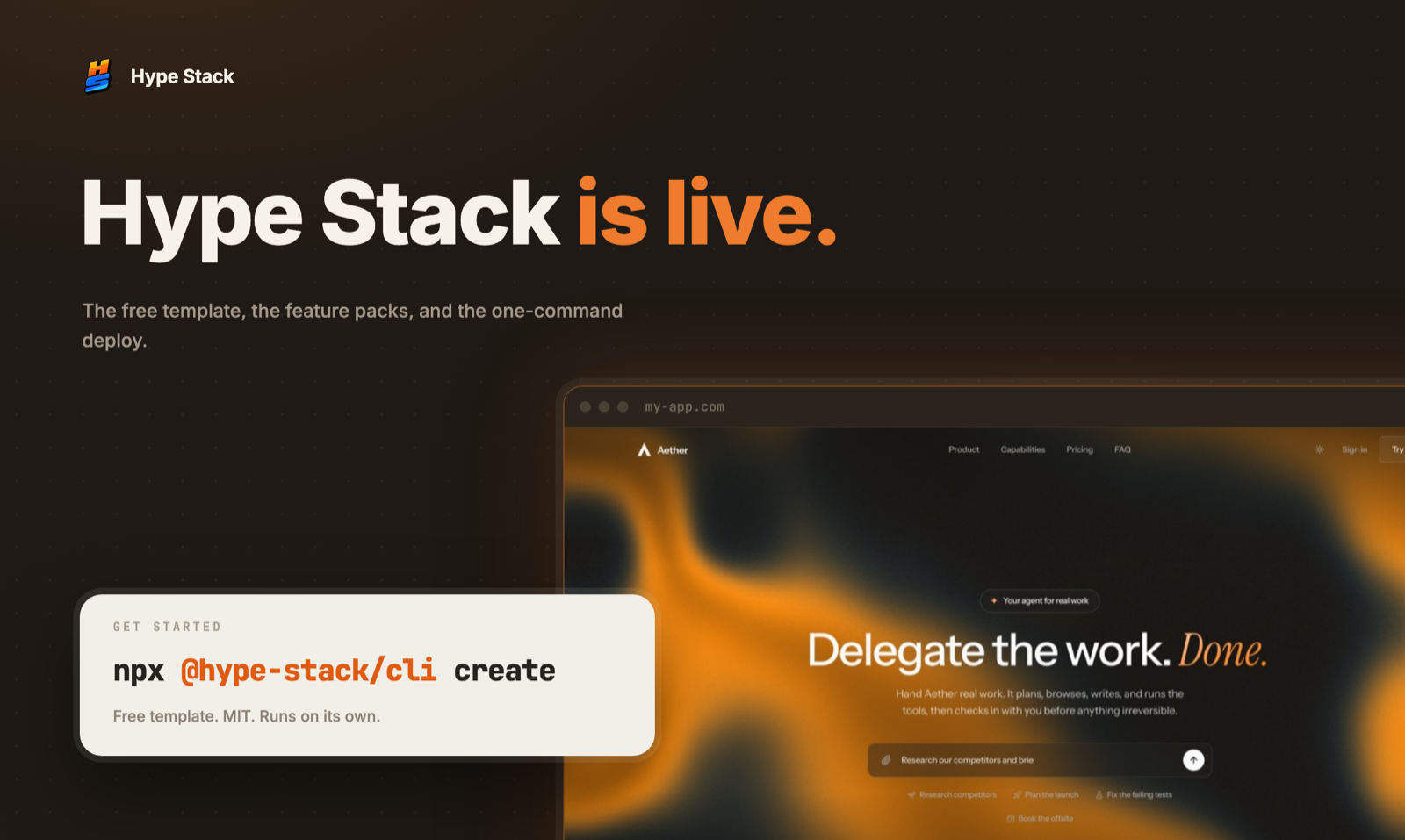
The free template has been out for a while. Today the whole thing ships. One command writes auth, billing, or teams into your repo as code you own, and another one deploys the stack.
I've built the same SaaS foundation about six times. Auth, organizations, billing, notifications, the invite email, the role checks on every route. Every boilerplate I tried handed me two hundred files I didn't ask for, and from that moment I owned all of them.
Hype Stack is my answer to that, and as of today, all of it is live: the template, the CLI, the pack catalog, the live previews, and the one-command deploy.
Start empty
The template ships the foundation and nothing else. React 19 with TanStack Router on the frontend, Hono with Prisma and Kysely over Postgres on the backend, TypeScript end to end, with the types flowing from backend routes straight into the frontend SDK. It's MIT licensed, it runs on its own, and it stays free.
npx @hype-stack/cli create my-appThat gives you an app that builds, typechecks, and boots. What it doesn't have is an opinion about which auth provider you use or whether you charge money. That's deliberate. Deleting someone else's code you don't understand is worse than writing your own, so the template makes you delete nothing. If the foundation is all you need, ship it as is and never give me a cent.
Features are code, not dependencies
When you do need a feature, you run compose and pick it. The CLI writes the feature into your repo the way shadcn/ui
writes components: actual source files at the paths your project already uses, not a package you configure and pray
over.
Picking Stripe billing writes 56 files into the project. The checkout route, the webhook handler in
libs/stripe/webhook.ts, the customer portal module, the Prisma models, the pricing cards and the plan-change dialog on
the frontend. The integration tests come along too, because code you own without tests is code you're afraid of.
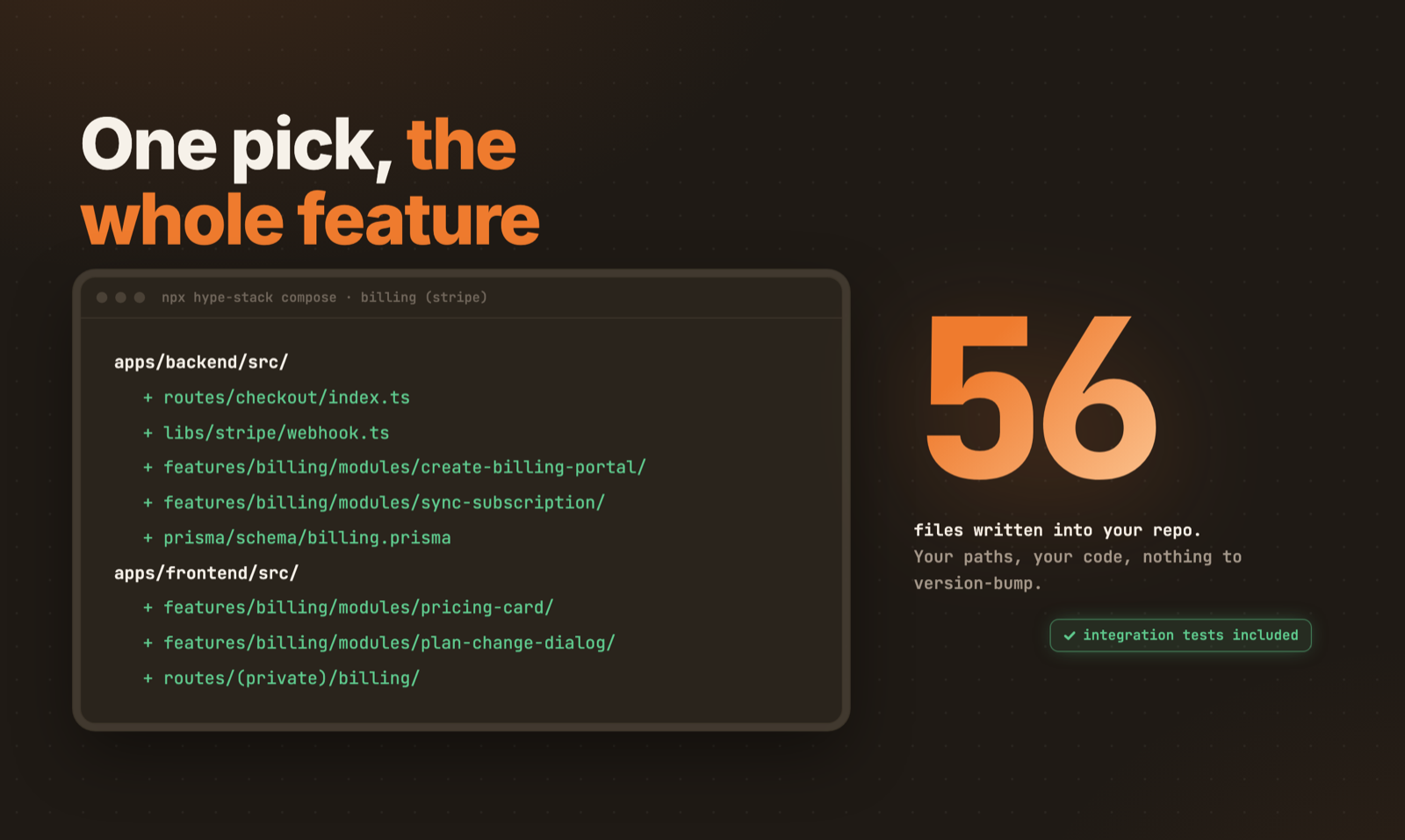 One pick in the compose prompt. The billing feature lands as source in your
 apps/backend and apps/frontend trees,
tests included.
From that point there's nothing to version-bump and nothing to rip out later. When your product needs checkout to behave differently, you edit the file.
What's in the catalog today
The launch catalog covers the features I kept rebuilding, plus a few I always wanted and never had time to do properly:
- Two starters: auth, sessions, and organizations, built on Better Auth or WorkOS.
- Four layouts: basic, glass, joyful, and a native app shell.
- Billing in three flavors: Stripe, Lemon Squeezy, or Polar.
- Teams: org management, memberships, invite emails, role checks.
- Notifications: in-app and email, with read state that survives a reload.
- Calendar, projects, whiteboard, newsletter: the collaborative and content-heavy stuff.
- Cookie consent, free, because charging for a cookie banner felt wrong.
Every pack has a live, clickable preview on the site. You can try the whiteboard, open the notifications inbox, or walk the checkout flow before you decide anything lands in your repo.
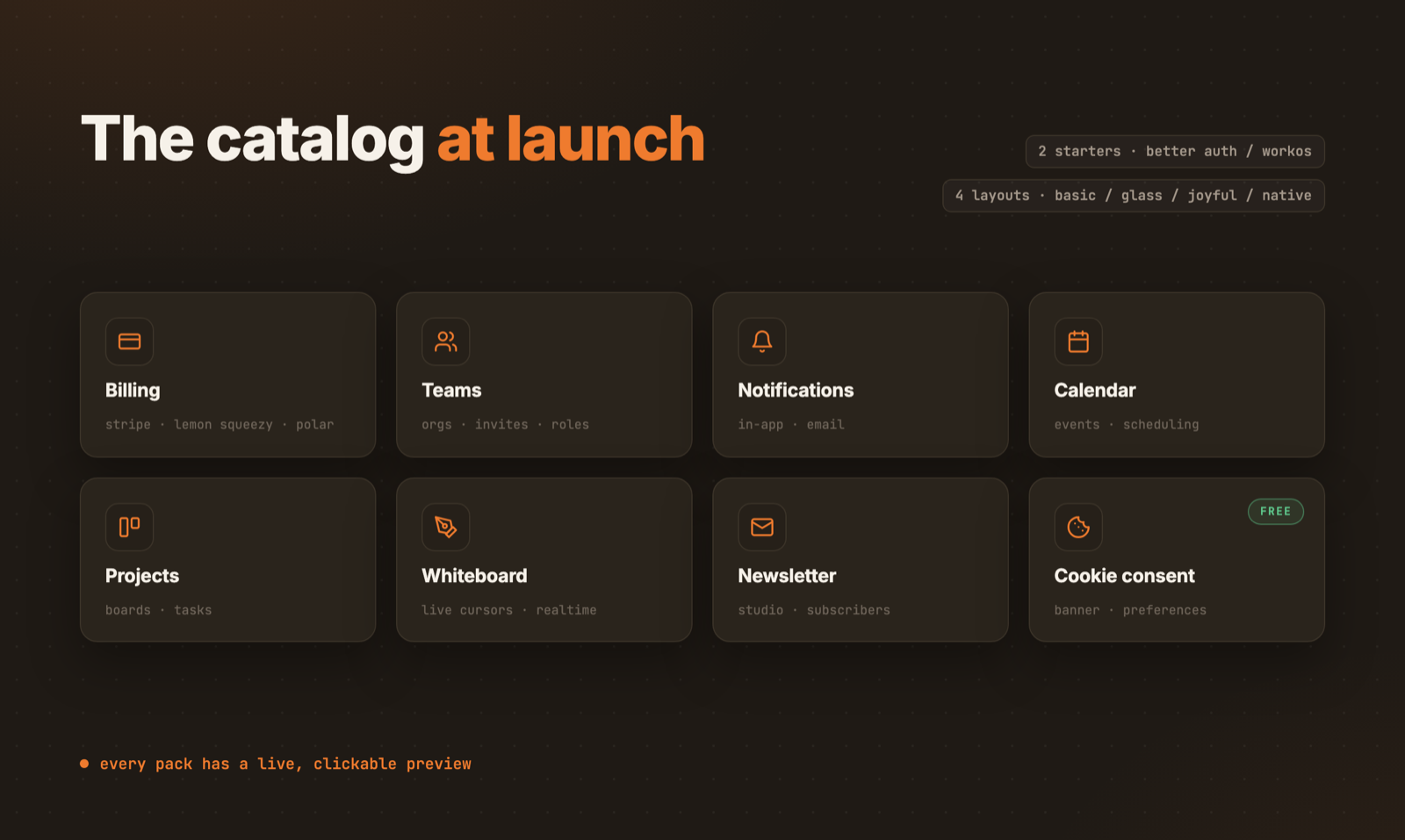 The catalog at launch. Each card opens an interactive preview of the real feature, not a screenshot.
One command to ship
The same CLI deploys the whole stack. deploy provisions the services, sets the environment variables, runs the
database migrations, and puts the frontend and backend live on Railway or Fly. Mobile apps and browser extensions have
their own targets.
And when one app in the stack fails to go out, the others still do. The deploy reports exactly which app failed, with the provider's own error and the command that unblocks it, instead of leaving you with half a stack and a shrug.
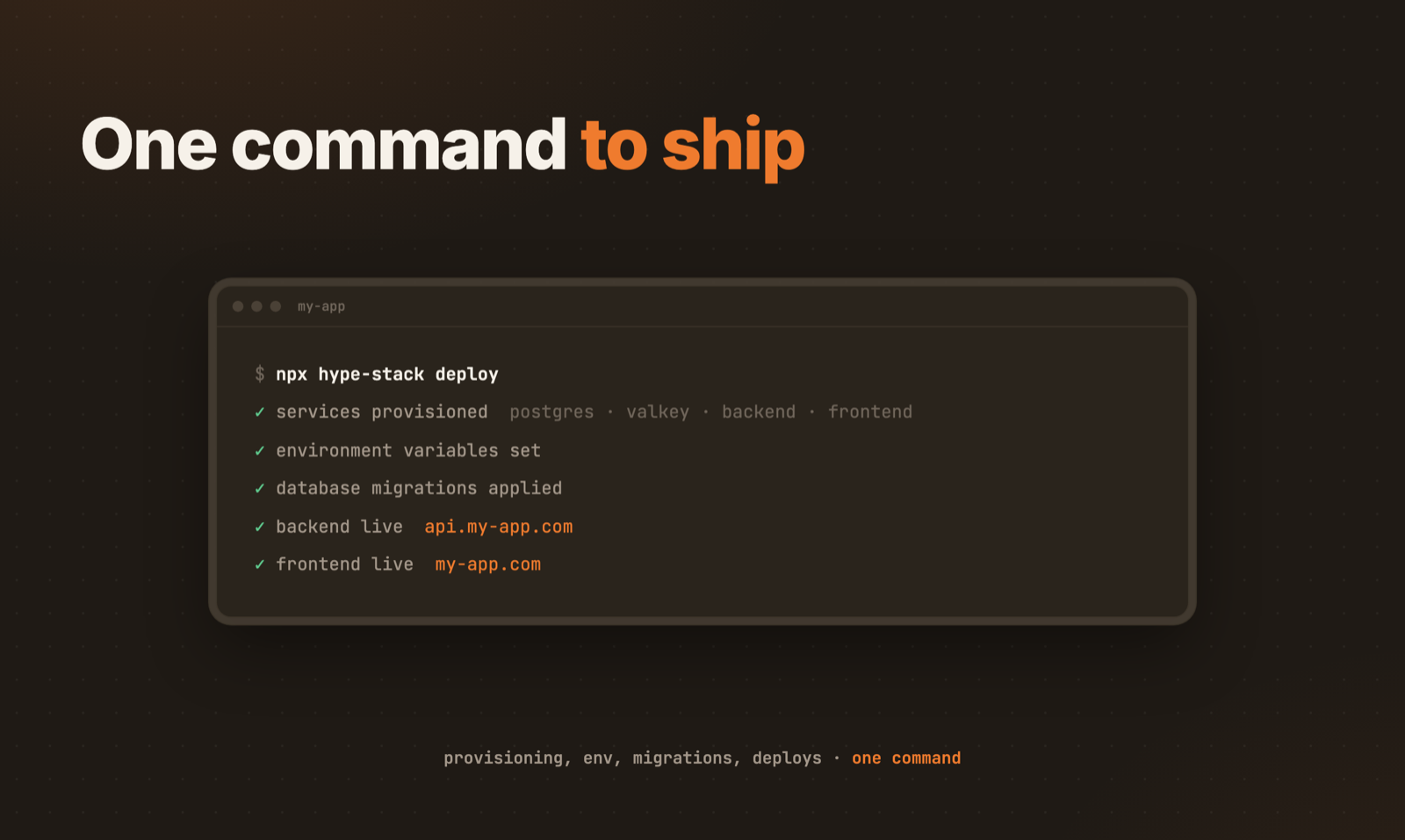 The whole stack, one command. Provisioning, env, migrations, and the deploys themselves.
The template also ships editor rules for AI tools. Cursor, Claude Code, and Copilot get the project's conventions and structure up front, so generated changes fit the codebase on the first try instead of the third.
How this is funded
The template is free forever, full stop. The feature packs are paid once and kept for good, and they fund maintaining the free part plus my other open-source work. I'd rather charge for optional packs than abandon the template in a year. The prices are on the pricing page, and there's nothing clever hidden in them.
Try it
If you've written the same auth, billing, and teams code more than once, the next project can start at the product instead of the plumbing:
npx @hype-stack/cli create my-appThen browse the packs, click through a preview or two, and compose the day you actually need a feature. The
docs cover every command, and if something breaks, tell me. The GitHub issues on
BetterTyped/hype-stack are read by the person who wrote the code, because
there's only one of him.